
Sourcing & Trade Guide
Wholesale African Food & Agro Products: Where to Source in Bulk
Comilmart Team
September 9, 2026
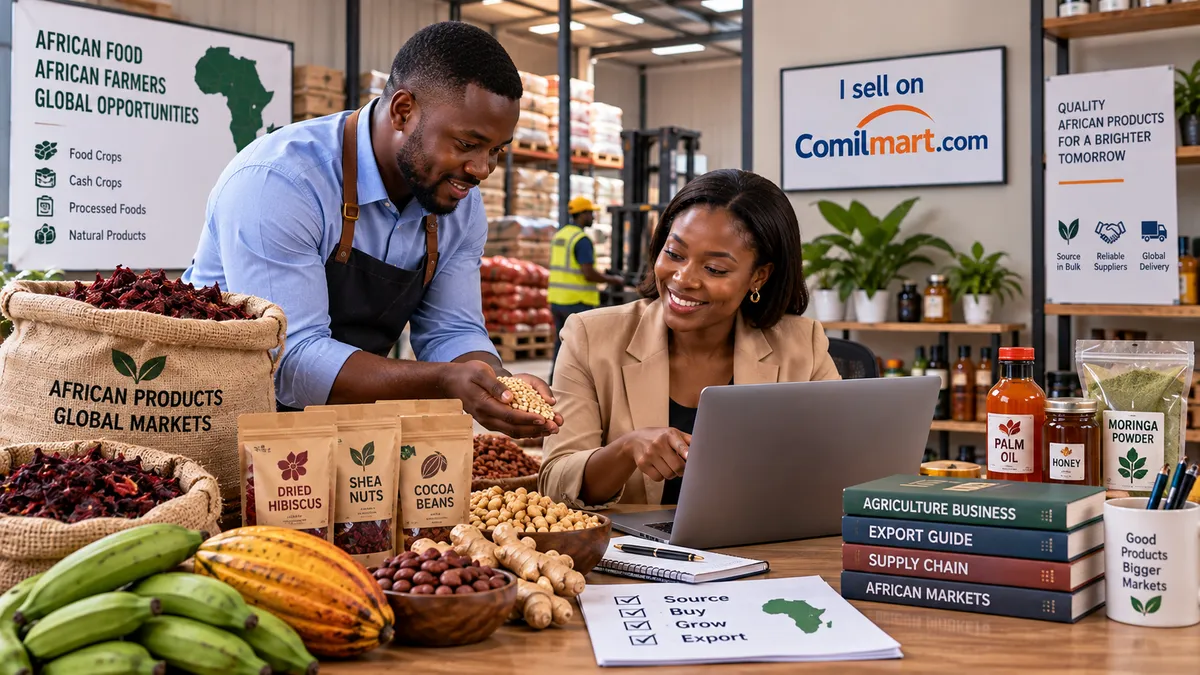
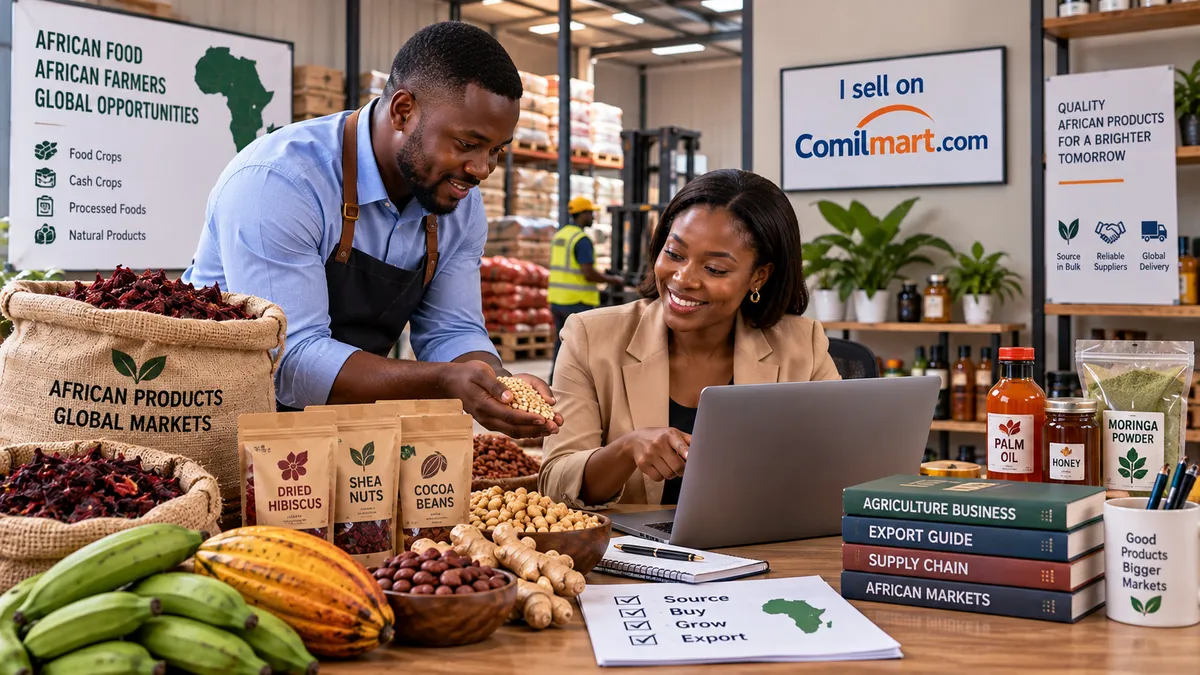
Agriculture and agro-processing represent one of Africa's deepest and most globally competitive manufacturing categories. The continent produces a significant share of the world's cocoa, cashews, and shea butter, alongside strong coffee, tea, and grain sectors — and increasingly, buyers are looking past raw commodity trading toward processed, value-added agro products that offer better margins and more differentiated positioning for their own businesses.
Understanding the value chain: raw vs. processed
One of the most important distinctions in this category is between raw commodity purchasing and sourcing processed or semi-processed goods. Buying raw cocoa beans is a fundamentally different business than buying cocoa butter or cocoa powder — the latter requires the supplier to have genuine processing capability, not just agricultural production or trading relationships. For most wholesale buyers outside the commodity trading business, sourcing processed products is the more practical entry point: it requires less specialized logistics knowledge, generally involves smaller minimum order quantities, and produces a product closer to what you'll actually resell or use.
Major categories worth knowing
Cocoa and cocoa derivatives
West Africa, and Ghana and Côte d'Ivoire in particular, produce a majority of the world's cocoa. Beyond raw beans, processed cocoa products — butter, powder, liquor, and nibs — offer buyers in food manufacturing, cosmetics (cocoa butter is a major cosmetic ingredient), and confectionery a more directly usable product.
Coffee
Ethiopia, Kenya, and Uganda all produce internationally respected coffee, with distinct flavor profiles that command genuine premium pricing in specialty coffee markets. Buyers sourcing coffee should pay particular attention to processing method (washed vs. natural), harvest freshness, and proper storage and shipping conditions, since coffee quality degrades meaningfully if handled poorly in transit.
Shea butter and cosmetic ingredients
West Africa, particularly Ghana, Nigeria, and Burkina Faso, is the world's primary source of shea butter, used extensively in cosmetics and skincare. Buyers should distinguish between raw/unrefined shea butter (retaining more natural scent and nutrients, often preferred for premium cosmetic positioning) and refined shea butter (more neutral in scent and color, sometimes preferred for mass-market formulations).
Cashews
Several African countries, including Côte d'Ivoire (the world's largest producer), Tanzania, and Nigeria, have significant cashew production. As with cocoa, the distinction between raw cashew nuts (requiring further processing) and processed, ready-to-eat cashews matters significantly for what kind of buyer relationship makes sense.
What to verify before buying in bulk
- Food safety compliance. For anything intended for human consumption, ask specifically about the food safety standards a supplier follows and whether they can provide relevant certification. International buyers, particularly those importing into the US or EU, should confirm a supplier's familiarity with the destination market's specific food safety requirements before committing to a large order.
- Harvest timing and freshness. Agricultural products are seasonal, and buying at the wrong point in a harvest cycle can mean either premium off-season pricing or, worse, product that's been stored longer than ideal. Ask suppliers directly about harvest timing relative to your intended order date.
- Traceability. Increasingly, international buyers — and their own end customers — want to know specifically where an agricultural product was grown and processed, not just the country of origin broadly. Suppliers who can speak specifically to their sourcing (which farms, which region, which cooperative) offer a meaningfully stronger value proposition than those who can only speak in general terms.
- Certifications relevant to your market. Organic, Fair Trade, and Rainforest Alliance certifications all carry real value in certain international markets and price premiums to match — confirm whether a supplier holds relevant certifications if your own customers care about these labels.
AGOA and US market access
For buyers importing into the United States, the African Growth and Opportunity Act (AGOA) provides duty-free access to the US market for many agricultural and food products from eligible sub-Saharan African countries, which can represent a meaningful cost advantage over sourcing the same category from a non-AGOA-eligible country. Eligibility varies by country and is reviewed periodically, so it's worth confirming a specific supplier's country currently qualifies before factoring this into your cost comparison.
Shipping and storage considerations
Agro products carry storage and transit requirements that differ meaningfully from manufactured goods. Cocoa, coffee, and cashews all require protection from moisture and temperature extremes during ocean freight, and quality can degrade noticeably if these conditions aren't managed properly. Ask suppliers directly about their packaging standards (moisture barriers, appropriate container types) and, where relevant, whether they have experience shipping to your specific destination market — a supplier with an established export history to your region has typically already solved these logistics problems.
Where to find verified agro product suppliers
Ghana and Côte d'Ivoire for cocoa, Ethiopia and Kenya for coffee, and Ghana and Nigeria for shea butter are the strongest starting points geographically, though genuine processors exist across the continent. On Comilmart, agro-product suppliers go through the same verification process as every other category before earning a Verified badge — particularly valuable here given how much traceability and food safety compliance matter.
See our guides to sourcing from Ghana and sourcing from Kenya for country-specific verification guidance relevant to this category.
Quality grading and what it means for pricing
Most agricultural commodities are traded against established grading systems that directly affect price — cocoa is graded on bean size, fermentation quality, and moisture content; coffee on bean size, defect count, and cupping score; cashews on kernel size and whole-vs-broken ratio. Understanding roughly where a supplier's stated grade sits within these systems helps you sanity-check pricing against market benchmarks, rather than relying purely on a supplier's own description of their product as "premium" or "export quality" without context for what that actually means numerically.
Managing price volatility
Agricultural commodity prices, cocoa and coffee especially, can swing significantly based on global harvest conditions, weather events, and broader commodity market dynamics — often independent of anything specific to an individual supplier. Buyers planning recurring orders should build some flexibility into their own pricing and planning to accommodate this volatility, and it's reasonable to ask a supplier directly how their own pricing responds to shifts in the underlying commodity market, since a transparent answer here is a good sign of a supplier who understands their own business and cost structure.
Building a direct relationship vs. buying through intermediaries
In agro products specifically, buyers often encounter a choice between sourcing directly from a processor and sourcing through a trading intermediary who aggregates product from multiple smaller producers. Direct sourcing generally offers better traceability and, at sufficient volume, better pricing, but requires the processor to have the scale and export capability to work with international buyers directly. Intermediaries can provide access to smaller producers who couldn't otherwise handle international logistics and documentation themselves, at the cost of an additional margin and, often, somewhat reduced traceability back to the original source. Neither approach is inherently wrong — the right choice depends on your volume, your need for traceability, and how much sourcing complexity you're equipped to manage directly.
Frequently asked questions
How do I know if a shea butter or cocoa supplier is actually a processor and not just a trader? Ask directly about their processing facility and request evidence — photos or video of actual processing equipment, not just finished product. A genuine processor should have no hesitation providing this.
Is organic or Fair Trade certification worth paying a premium for? That depends entirely on whether your own end customers value and will pay for that certification — it's a genuine cost driver on the supply side, so it only makes sense to prioritize if it translates into value on your sales side too.
What's the biggest risk in this category specifically? Quality degradation from improper storage or shipping, more than outright fraud — even a genuine, verified supplier's product can arrive in poor condition if packaging and transit conditions weren't managed properly, which is why asking specifically about a supplier's shipping practices matters as much as verifying their legitimacy.
Building toward a long-term supply relationship
Agro products, more than most categories, benefit from continuity in a supply relationship — a processor who understands your specific quality requirements, packaging preferences, and order timing over multiple seasons will generally deliver more consistent results than starting fresh with a new supplier every time. Given the seasonal nature of most agricultural products, it's worth discussing with a supplier early on how they plan for your recurring needs across harvest cycles, including how they handle any gaps between harvests if you need year-round supply — some processors maintain their own storage to bridge these gaps, while others may need you to plan orders around specific harvest windows.
Sample evaluation: what to actually check
When a supplier sends a sample, resist the temptation to simply confirm it looks and tastes or smells right, and instead evaluate it against the specific criteria that matter for your use case. For cocoa and coffee, this might mean a proper cupping or tasting evaluation rather than a casual taste test. For shea butter, checking texture, scent intensity, and how it behaves when melted and re-solidified (relevant if you're using it as a cosmetic ingredient) tells you more than appearance alone. Keep samples from multiple suppliers to compare side by side rather than evaluating each one in isolation days or weeks apart, since direct comparison reveals differences that are much harder to judge from memory.
Working with cooperatives vs. private processors
A meaningful share of African agro production, particularly shea butter and some cocoa, moves through farmer or producer cooperatives rather than purely private processing companies. Cooperatives can offer genuine advantages — often stronger traceability back to specific communities, and a supply chain story that resonates with buyers focused on ethical sourcing — but they can also involve more layers of coordination and, in some cases, more variable capacity to handle large international orders on tight timelines compared to a dedicated private processing operation built specifically around export logistics. Neither structure is inherently better; understanding which one you're actually working with, and what that means for lead time and communication, helps set realistic expectations from the outset rather than assuming every supplier operates the same way regardless of their underlying structure.
Whichever structure you work with, building in a modest time buffer for your first order remains sound practice — both cooperative and private processing arrangements can run into unexpected delays on a first order simply from the process of establishing a new working relationship, regardless of how well-organized either side is individually.
Getting started
Create a free buyer account on Comilmart to browse Verified agro-product suppliers by category and country. See our complete guide to sourcing wholesale from Africa for broader guidance that applies across every category covered in this series.