
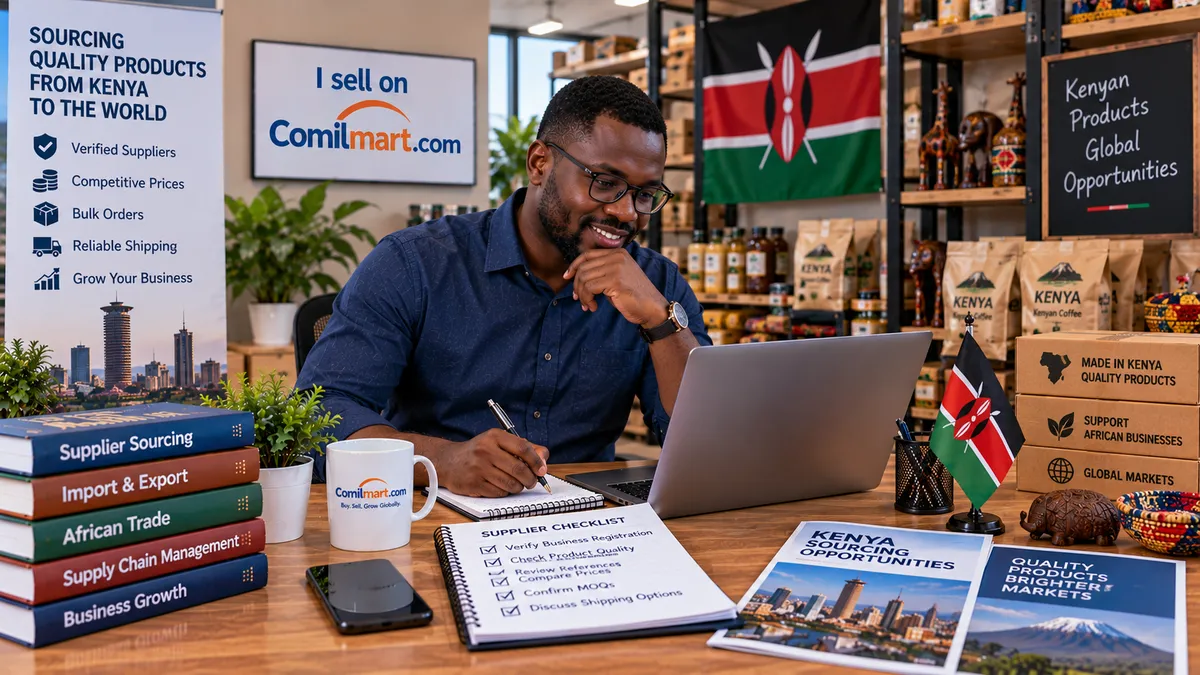
Sourcing & Trade Guide
How to Find Verified Wholesale Suppliers in Kenya
Comilmart Team
September 9, 2026
Kenya has quietly built one of East Africa's strongest manufacturing and agro-processing bases, with particular strength in tea and coffee processing, horticulture and cut flowers, textiles, and increasingly, light manufacturing and packaged consumer goods. It's also a market where, as with most of Africa, the gap between "suppliers that exist" and "suppliers a first-time buyer can easily find and trust" is real.
Why verification matters when buying from Kenya
Kenya is a regulated exporter. Tea, coffee, horticulture and manufactured goods each sit under their own licensing or inspection regime, which means a genuine supplier leaves a paper trail you can check. That is good news for buyers, because a supplier who cannot produce any of it is telling you something. The authorities themselves take the issue seriously: the Agriculture and Food Authority (AFA) has stated that only coffee exporters published in the Kenya Gazette are recognised as legitimate and that unlicensed exporters face legal action, and the Kenya Bureau of Standards (KEBS) introduced track-and-trace quality marks in 2015 specifically to combat counterfeit marks.
Where to actually look
1. Verified marketplaces
The fastest way to reduce risk is starting with a platform that verifies suppliers before you ever see the listing. On Comilmart, Kenyan manufacturers go through a documented business verification process before earning a Verified badge — meaning the groundwork of checking they're a real, registered business has already been done.
2. Government trade bodies
The Kenya Export Promotion and Branding Agency (KEPROBA) maintains resources for export-ready Kenyan manufacturers and can be a useful secondary reference point when evaluating a supplier's legitimacy and export readiness.
3. Industry associations
Sector-specific bodies — for horticulture, textiles, and tea and coffee particularly — often maintain their own member directories, which can be a useful cross-check against a supplier's claims.
How a Kenyan export works, and the documents behind it
Understanding the process helps you ask the right questions. A Kenyan exporter normally registers a company or business through the eCitizen platform and holds a certificate of incorporation and a company KRA PIN. Product-specific registrations and licences follow, depending on what is being sold. Then comes a sales contract with the buyer and a licensed customs clearing agent, who declares the consignment using documents such as the commercial invoice, certificate of origin, packing list, relevant permits and the exporter's PIN certificate. Ask your supplier which of these they hold for your product.
- Company registration and KRA PIN: proof that the business legally exists and is tax-registered.
- KEBS standards marks: the Standardization Mark (S-Mark) certifies that a locally manufactured product conforms to a Kenyan standard, while the Diamond Mark of Quality is a voluntary mark of excellence.
- KEPHIS phytosanitary certificate: the Kenya Plant Health Inspectorate Service (KEPHIS) is the national plant protection authority and issues phytosanitary certificates for horticultural exports after inspection.
- Tea Board of Kenya licence: the Tea Board regulates the tea sub-sector under the Tea Act, 2020, including licensing of exporters and other dealers.
- AFA coffee licence: AFA licenses coffee dealers, including buyers, warehousemen and agents, under the Crops Act.
What real verification looks like
A legitimate Kenyan manufacturer ready to work with wholesale buyers should be able to provide:
- Business registration confirmed through Kenya's Business Registration Service (BRS)
- Real photos or video of their actual production or processing facility
- A track record — marketplace reviews, export history, or referenceable past clients
- Clear written terms on MOQ, pricing, and lead time before asking you to commit
A step-by-step verification checklist
- Step 1, confirm the company exists. Ask for the registration number and run an official search through the BRS on eCitizen. The resulting CR12 shows the company name, registration number and date, registered office, and details of directors and shareholders for private companies. A search costs about KSh 650 at the time of writing, so check the current fee.
- Step 2, ask for the KRA PIN certificate and check the business name matches.
- Step 3, check the product permits. For manufactured goods, ask for the KEBS permit number. KEBS says permits can be checked on its website or app, by SMS to 20023 in the format SM#PERMITNUMBER, or by calling 1545. Confirm the current method on kebs.org before relying on it.
- Step 4, check the sector licence. Tea exporters should hold a Tea Board licence, coffee dealers an AFA licence, and horticulture exporters should be able to show KEPHIS certification for their shipments.
- Step 5, see the operation. Request a live video walk-through of the facility, not just photos.
- Step 6, order a sample before committing to bulk, and compare it against the listing.
On Comilmart, much of this groundwork is covered by the Verified badge process, and you can browse the supplier directory, send a request for quotation (RFQ), and chat directly with suppliers before deciding.
Red flags
- Contact only through personal WhatsApp or social media, with no verifiable business presence
- Pressure to send a full payment immediately through an informal channel
- Reluctance to provide a sample before a bulk order
- Product photos that don't match the stated scale of production
Categories where Kenya genuinely excels
Tea and coffee (processed and packaged), cut flowers and horticultural products, leather goods, textiles, and an increasingly sophisticated packaged food and beverage sector are all areas where Kenyan manufacturers compete well internationally on both quality and price.
Tea and coffee. Kenya exported about 500.8 million kilograms of tea in 2024, earning roughly KSh 155 billion, with Pakistan, Egypt and the UAE among the top destinations, according to Tea Board figures reported by Food Business Middle East. For tea, ask for the Tea Board licence. For coffee, check that the exporter appears among gazetted, AFA-licensed dealers.
Horticulture and cut flowers. Europe remains Kenya's largest flower market, and cut flowers have historically been the largest share of certified horticultural exports. Because these goods are perishable and plant-health rules apply, a credible supplier should be comfortable discussing KEPHIS inspection and phytosanitary certification.
Leather. KEBS gazetted 13 new leather quality standards in November 2021, so ask finished-goods suppliers which standard their products are tested against. Much of Kenya's leather exports have historically been raw hides, so suppliers of finished leather goods are worth vetting carefully.
Textiles and EPZ apparel. Apparel is Kenya's largest benefit under the US AGOA trade programme, with apparel exports of about KSh 60.6 billion in 2024 according to Kenyan government figures. Much of this is produced in Export Processing Zones, so ask for proof if a supplier claims EPZ status.
Packaged foods and beverages. Look for a KEBS mark and permit number on the label and verify it using the KEBS channels above. Browse groceries and food listings for retail-ready products.
Payment safety and shipping basics
Avoid paying the full amount upfront to an unverified supplier through an informal channel. On Comilmart, payment is held until you confirm delivery, and you can order samples and use trade financing for larger purchases; see our buyer protection page for details. For shipping, bulk sea freight generally leaves Kenya through the port of Mombasa, while smaller or urgent consignments are usually flown out of Nairobi's Jomo Kenyatta International Airport (JKIA). Agree on who arranges the clearing agent and who pays duties before you confirm an order. Our complete guide to sourcing from Africa covers terms in more depth, and if you also source in the west of Kenya, see our guides to wholesale suppliers in Kisumu and wholesale suppliers in Nakuru.
Frequently asked questions
How do I check that a Kenyan company is really registered? Ask for the registration number and run an official search through the Business Registration Service on eCitizen, which produces a CR12 showing the company's details.
What does the KEBS mark on a product mean? The Standardization Mark certifies that a locally manufactured product conforms to a Kenyan standard. You can check the permit number with KEBS.
Do I need a KEPHIS certificate for flowers or produce? Horticultural exports are certified by KEPHIS, which issues phytosanitary certificates. Importing rules vary by destination, so check your own country's requirements.
Can I order a sample first? Yes. Ordering a sample before a bulk order is one of the simplest ways to check quality, and Comilmart supports sample ordering. A supplier who refuses is a red flag.
Getting started
Create a free buyer account on Comilmart to browse Verified Kenyan suppliers by category, and see our complete guide to sourcing from Africa for the broader context on payment terms, MOQs, and shipping.