
Sourcing & Trade Guide
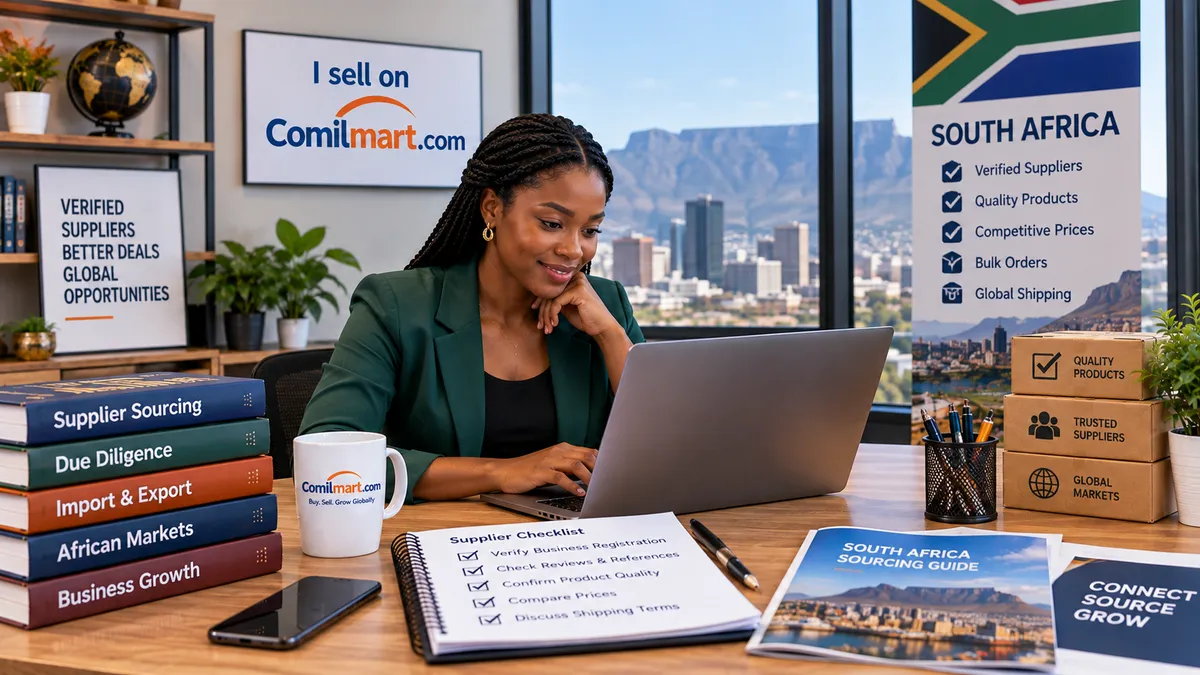
How to Find Verified Wholesale Suppliers in South Africa
Comilmart Team
September 9, 2026
South Africa occupies a unique position on the continent: it's the most industrialized economy in Africa, with a manufacturing base that spans processed foods and beverages, automotive components, textiles, mining equipment, chemicals, and increasingly sophisticated consumer goods. It also has more mature trade infrastructure and business regulation than most of the countries covered elsewhere in this series, which in some ways makes sourcing here more straightforward — but the fundamentals of verification still matter just as much.
Why South Africa is worth serious consideration
A few things set South African manufacturing apart from other African sourcing destinations:
- Industrial depth. South Africa has decades of manufacturing infrastructure behind it, including in more complex, higher-value categories like automotive parts, machinery, and chemicals — not just raw or lightly processed goods. This is one of the few African markets where a buyer can realistically source precision-manufactured components rather than only raw materials or basic consumer goods.
- Regulatory maturity. Business registration, quality standards, and trade compliance frameworks are generally more developed and consistently enforced than in many other African markets, which reduces (though doesn't eliminate) the verification burden on a buyer.
- Strategic trade position. With ports on both the Atlantic and Indian Ocean coasts and status as a gateway to the Southern African Development Community (SADC) region, South Africa offers meaningful logistics advantages for buyers targeting the wider southern African market, not just South Africa itself.
- The EU-SADC Economic Partnership Agreement gives South African exporters preferential access to European markets, which can translate into competitive pricing for buyers sourcing goods that ultimately move through or to Europe. In practice, this means a South African manufacturer exporting to the EU faces lower or eliminated tariffs than a competitor in a country without this agreement, and that cost advantage often gets passed along, at least in part, to the buyer.
A quick tour of South Africa's regional manufacturing strengths
South Africa's manufacturing base isn't evenly distributed — different provinces have developed genuinely distinct specializations, which is worth knowing if you're trying to identify the right region for your specific category:
- Gauteng (Johannesburg and Pretoria) is the industrial and automotive heartland, with the country's strongest concentration of vehicle assembly, machinery, and general manufacturing.
- KwaZulu-Natal (centered on Durban, home to the continent's busiest container port) has particular strength in textiles, sugar processing, and chemicals, alongside being the country's primary logistics gateway.
- Western Cape (Cape Town) leads in wine, agriculture and food processing, and has a growing tech and creative industries presence alongside its traditional strengths.
- Eastern Cape is a secondary automotive manufacturing hub, hosting several major vehicle plants and their associated component suppliers.
Knowing this can help narrow your search — a buyer looking for wine or processed foods has good reason to focus on Western Cape suppliers, while an automotive parts buyer is more likely to find genuine manufacturing depth in Gauteng or the Eastern Cape.
Where to actually look for suppliers
1. Verified marketplaces
As with every market covered in this series, starting with a platform that verifies suppliers before listing them removes the majority of first-order risk. On Comilmart, South African manufacturers go through a documented verification process — checking real business registration and product or facility evidence — before earning a Verified badge.
2. CIPC — South Africa's company registry
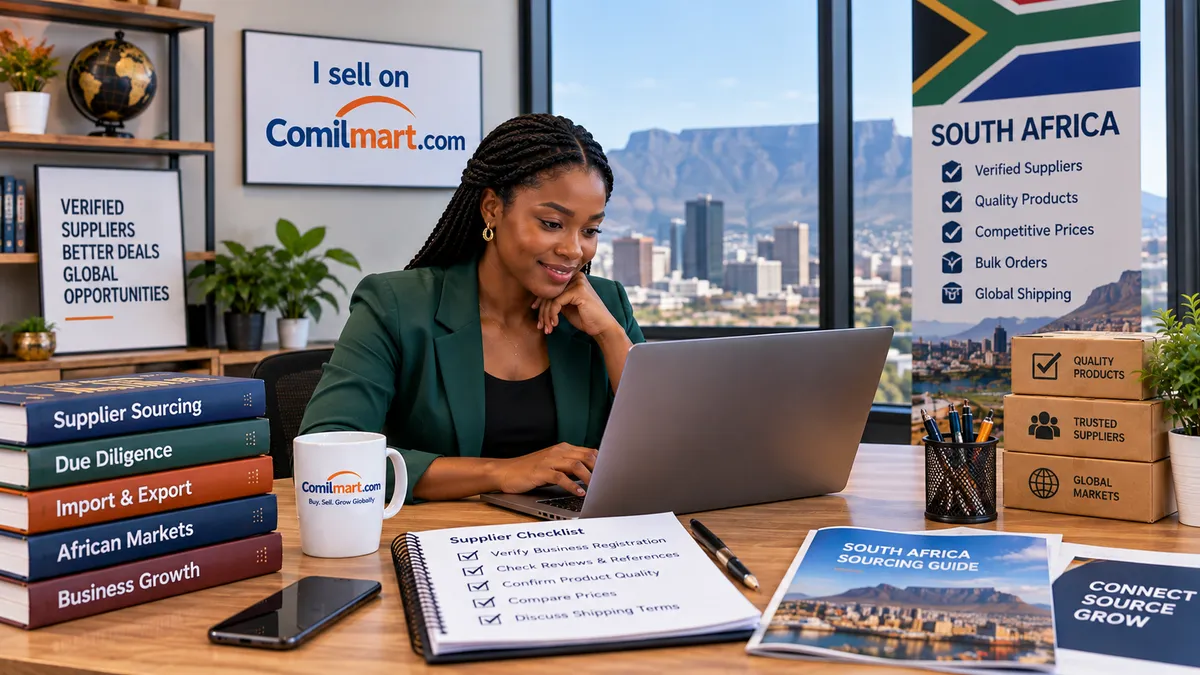
Every legitimate South African company should be registered with the Companies and Intellectual Property Commission (CIPC), the government body responsible for company registration and regulation. A supplier who can't or won't confirm their CIPC registration number is a serious red flag, since checking this is straightforward and any genuine business will have it readily available. CIPC registration numbers follow a predictable format, and the commission's own systems allow basic verification of whether a given registration is active and in good standing.
3. the dtic and Trade and Investment South Africa
South Africa's Department of Trade, Industry and Competition (the dtic) runs export development and promotion programs through its Trade and Investment South Africa division, supporting export-ready manufacturers with market access and incentive schemes like the Export Marketing and Investment Assistance program. A manufacturer actively engaged with these programs is generally a positive signal of genuine export ambition and capability — it takes real paperwork and compliance effort to participate, which tends to filter out less serious operators.
4. Industry-specific and provincial bodies
South Africa's provinces each maintain their own trade and investment promotion agencies — Wesgro for the Western Cape being one of the most active — which can be a useful additional reference point, particularly for buyers interested in a specific region's manufacturing base. Sector associations, particularly in wine, automotive components, and textiles, also maintain their own member directories worth cross-checking against a supplier's claims.
What genuine verification looks like
Before committing to a South African supplier, look for:
- A CIPC registration number you can independently verify
- Real photos or video of the actual production facility — South African manufacturers with genuine scale are generally comfortable providing this, and reluctance here is worth noting
- Clear compliance with relevant quality or safety standards for their category, particularly SABS (South African Bureau of Standards) certification where applicable, and especially important for food, cosmetics, and anything destined for the EU market where compliance documentation is often requested at customs
- A track record — export history, marketplace reviews, or referenceable existing clients
- Willingness to provide a sample before committing to a bulk order
- Clear, itemized pricing that distinguishes product cost from freight, insurance, and any applicable duties, rather than a single bundled figure that's hard to compare against other quotes
Red flags that apply here too
South Africa's more mature business environment doesn't eliminate risk entirely. Watch for:
- A "manufacturer" who is actually a reseller or trading company without disclosing this — ask directly where the product is actually made, and don't be satisfied with a vague answer
- Pressure to bypass secure payment channels in favor of a direct bank transfer, especially early in a relationship
- Vague or evasive answers about production capacity relative to the order size they're quoting — a genuine manufacturer should be able to speak specifically about their capacity
- No clear answer on lead times or an unwillingness to commit to anything in writing before payment
Categories where South Africa genuinely excels
Wine and beverages remain one of South Africa's best-known export categories, with a genuinely internationally competitive industry backed by decades of viticulture expertise. Processed and packaged foods — from preserves and condiments to snack foods — represent a growing category as the country's food manufacturing sector modernizes. Automotive components and parts benefit from the country's established vehicle assembly industry and the supplier ecosystem that's grown around it. Textiles and leather goods draw on both traditional craft and more modern manufacturing capacity. Mining equipment and industrial hardware reflect the country's mining heritage and the specialized machinery that industry has always required. And a growing cosmetics and personal care sector, often built around indigenous plant extracts and ingredients, is increasingly finding international buyers.
Typical lead times and what affects them
South African manufacturing lead times tend to be more predictable than in some other African markets, reflecting the more established production infrastructure, but still vary meaningfully by category. Standard catalog items from an established manufacturer might ship within one to two weeks of order confirmation; custom orders, particularly anything requiring new tooling or a dedicated production run, more realistically run four to eight weeks. Building a buffer into your own planning, especially for a first order with a new supplier, remains good practice regardless of how established the market is.
Ports and logistics worth knowing
Durban is the busiest container port on the African continent and South Africa's primary gateway for both imports and exports, making it the most likely departure point for goods sourced from KwaZulu-Natal and much of the interior. Cape Town serves the Western Cape's wine and agricultural exports, while the newer deepwater port at Ngqura in the Eastern Cape has been developed specifically to support the automotive and manufacturing sector in that region. Understanding which port a supplier is likely shipping from can help you estimate transit times more accurately, since routes and shipping line frequency differ meaningfully between them.
Quality certifications worth asking about
Beyond CIPC business registration, category-specific quality marks are worth confirming depending on what you're sourcing. SABS (South African Bureau of Standards) certification applies across many manufactured goods categories and signals compliance with recognized national standards. For food products, look for compliance with the relevant food safety standards your destination market requires — a genuine South African food manufacturer exporting internationally should already be familiar with these requirements even if your specific market's standard is new to them. For wine specifically, Wine of Origin certification confirms authentic regional sourcing, which matters both for quality assurance and for marketing purposes in your own market.
Frequently asked questions
Is it harder to negotiate with South African suppliers than elsewhere in Africa? Not particularly — if anything, the more established business culture often means clearer, more predictable communication and documentation, though pricing may run somewhat higher than in markets with lower production costs, reflecting the more developed infrastructure and labor market behind it.
Do South African suppliers typically speak English? Yes — English is one of South Africa's official languages and the standard language of business, which removes a communication barrier that can complicate sourcing in some other markets.
What's the biggest mistake first-time buyers make sourcing from South Africa? Assuming the country's more developed infrastructure means verification doesn't matter as much. It still does — a more mature business environment reduces certain risks but doesn't eliminate the need to confirm registration, request evidence of production capability, and start with a modest order before scaling up.
Building a long-term relationship with a South African supplier
As with sourcing anywhere, the first order with a new South African supplier is really about establishing trust in both directions — confirming they can deliver what they claim at the quality and timeline promised, and giving them confidence you're a reliable buyer worth prioritizing as the relationship grows. Communication style matters here more than buyers sometimes expect: South African business culture tends toward direct, plain-spoken communication, and suppliers generally respond well to buyers who are similarly clear about expectations, timelines, and any quality concerns, rather than communication that's overly indirect or leaves room for misunderstanding. Establishing a regular point of contact on both sides, rather than routing every conversation through whoever happens to be available, also tends to smooth out the inevitable small issues that come up in any ongoing supply relationship — a shipment running a few days late, a minor quality question, a request to adjust an upcoming order's specifications. None of these are unusual in a healthy long-term wholesale relationship; what matters is having established, reliable communication in place before they come up.
Time zone alignment is another practical advantage worth noting: South Africa sits within two hours of Central European Time year-round, which for buyers in Europe and much of the rest of Africa means genuine overlap in working hours for real-time communication — a small but meaningful convenience compared to sourcing relationships spanning a much larger time difference, where every exchange costs a full day of back-and-forth.
Getting started
Create a free buyer account on Comilmart to browse Verified South African suppliers by category. This completes our country-specific series — see our guides to Nigeria, Kenya, and Ghana, or the complete guide to sourcing from Africa for the broader picture that applies across every market covered in this series.