
Sourcing & Trade Guide
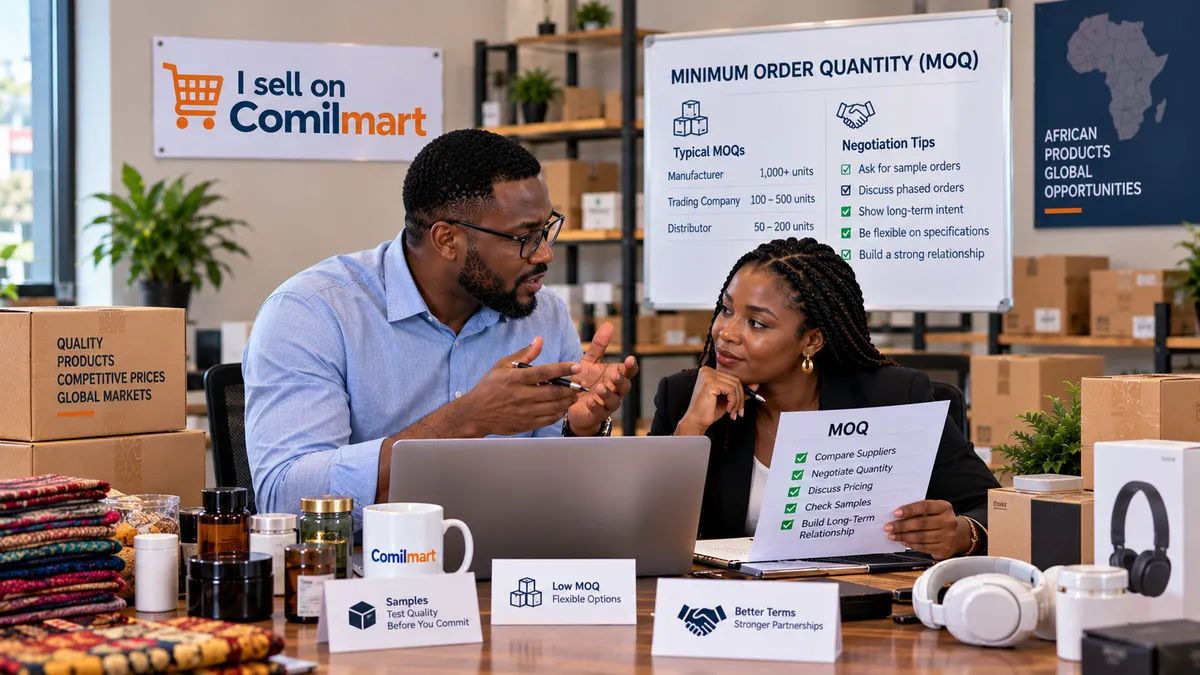
Understanding Minimum Order Quantities (MOQs) — and How to Negotiate Them
Comilmart Team
August 14, 2026
Almost every wholesale listing you encounter will show a minimum order quantity — often abbreviated MOQ — sitting right next to the price. For buyers new to wholesale sourcing, this single number can be confusing, intimidating, or both. Why does a supplier care how much you buy? Can that number actually move? And how do you figure out whether a given MOQ genuinely fits your situation? This guide covers all of it — what MOQ actually represents, why it exists, and practical, specific tactics for negotiating it when it doesn't quite fit what you need.
What MOQ actually represents
A minimum order quantity is the smallest amount of a product a supplier is willing to sell in a single order. It isn't an arbitrary number picked to inconvenience smaller buyers — it reflects the real, fixed costs a manufacturer takes on every time they run a production batch. Setting up a production line, sourcing raw materials in bulk, running quality control, and preparing an export shipment all cost roughly the same whether the order is for 200 units or 2,000. Below a certain volume, those fixed costs simply can't be recovered by the sale price, and the order stops making financial sense for the supplier to accept at all.
Understanding this is useful context going into any MOQ conversation: you're not asking a supplier to do you a favor by lowering their number — you're asking them to accept a different balance between fixed-cost recovery and winning your business. Framing it that way, even just in your own head, tends to lead to more productive conversations than treating MOQ as an arbitrary obstacle.
Why MOQ varies so much between suppliers and product categories
You'll notice MOQ can range enormously — from a few dozen units for a simple, low-complexity product to several thousand for something requiring specialized tooling or custom materials. A few factors drive this variation:
- Production complexity. A product requiring custom molds, specialized machinery setup, or multi-stage assembly generally carries a higher MOQ, because the fixed setup cost per production run is higher.
- Raw material sourcing. If a supplier needs to order raw materials in bulk from their own upstream suppliers to fulfill your order, their MOQ often reflects whatever minimum their own material suppliers require of them.
- Customization level. A fully custom product — your own branding, packaging, or specifications — typically carries a higher MOQ than an off-the-shelf item the supplier already produces at scale for many buyers.
- Supplier size and strategy. Larger manufacturers with high-volume production lines often set higher MOQs simply because smaller orders don't fit efficiently into their existing production schedule. Smaller manufacturers, by contrast, sometimes offer lower MOQs specifically to compete for buyers the larger players won't accommodate.
Is the listed MOQ actually fixed?
Often, no — or at least not as fixed as it appears on the listing page. Many suppliers publish a "standard" MOQ that reflects their most efficient production batch size, but retain real flexibility below that number, especially for a buyer who approaches the conversation the right way. That said, some MOQs genuinely are hard constraints, particularly when they're driven by an upstream raw-material minimum the supplier themselves can't get around. The only way to know which situation you're in is to ask directly, with a clear and specific request.
How to actually negotiate a lower MOQ
If the listed MOQ is higher than what you need, here are approaches that genuinely tend to work, in roughly the order worth trying them:
1. Ask directly, with a specific number and a real reason
Vague requests like "can you lower your MOQ?" rarely go anywhere. A specific ask — "I'd like to order 150 units instead of your listed 300; I'm testing demand in a new market before committing to a larger order" — gives the supplier something concrete to consider and shows you're a serious buyer, not just fishing for a discount.
2. Offer to pay a premium for the smaller quantity
If the supplier's real constraint is covering their fixed costs, offering a higher per-unit price in exchange for a smaller order directly addresses that constraint. This often works even when a flat "please lower your MOQ" request wouldn't, because you're solving their actual problem rather than just asking them to absorb the cost themselves.
3. Frame it as a trial order toward a larger future relationship
Suppliers are often more willing to flex on a first order specifically because they're weighing it against the value of winning a longer-term buyer relationship. Being upfront that you're testing the waters before scaling up — and genuinely meaning it — gives them a reason to make an exception now in exchange for your future business.
4. Ask about their standard sample program instead
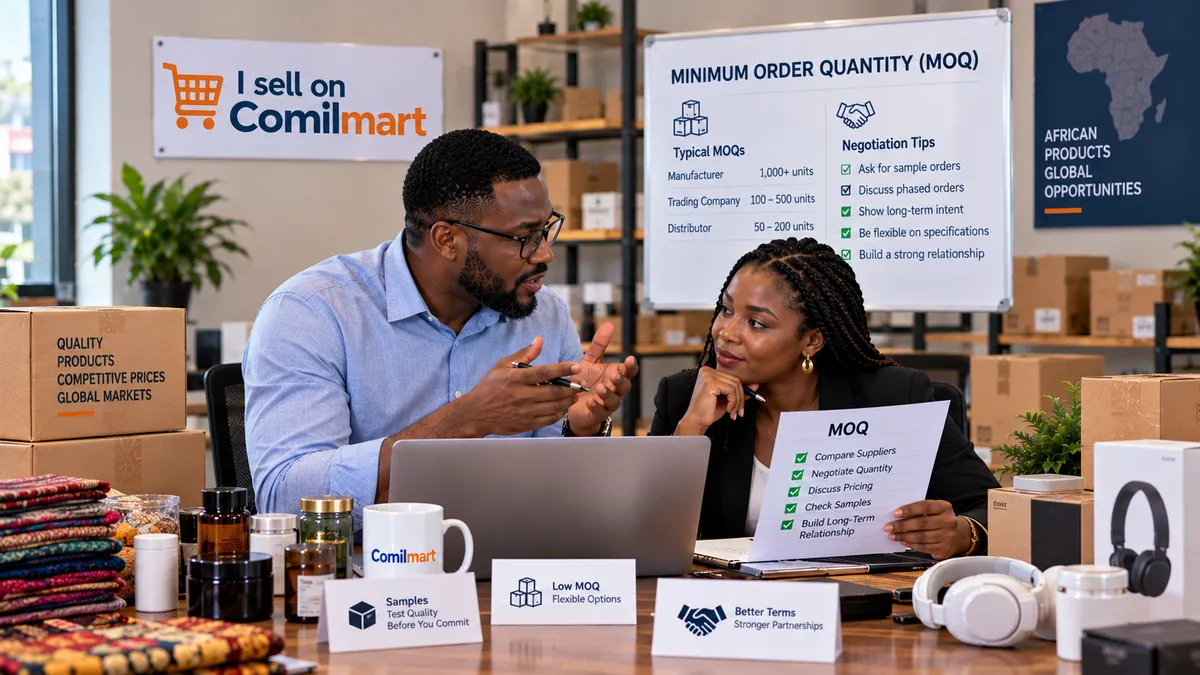
If a supplier offers formal sample ordering, that's often a built-in, no-negotiation-needed way to get a smaller quantity than their stated MOQ, precisely because sample pricing is already designed to cover the supplier's costs at low volume.
5. Look for similar suppliers with a naturally lower MOQ
If a particular supplier genuinely can't flex, it doesn't mean the product category can't be sourced at a smaller quantity elsewhere. Smaller or newer manufacturers in the same category sometimes offer meaningfully lower MOQs as a way to compete for buyers the bigger players turn away.
What to do if you genuinely need less than any available MOQ
Sometimes no amount of negotiation gets you below what you actually need. In that situation, a few options are worth considering: buying the full MOQ and reselling or storing the surplus if that's financially workable; splitting an order with another buyer who needs the same product, effectively combining two smaller needs into one order that meets the MOQ; or reconsidering whether a retail purchase, even at a higher per-unit price, might actually be the more sensible choice for your specific volume. None of these are failures — they're just recognizing that wholesale buying isn't the right fit for every situation, and that's fine.
A note on trust while negotiating
MOQ negotiation is also, quietly, a useful window into how a supplier operates. A supplier who engages seriously with a specific, reasonable request — even if the ultimate answer is no — is generally showing you the kind of communication you can expect after you've placed an order. One who ignores specifics, gives inconsistent answers across different conversations, or seems to be making up numbers on the spot is giving you useful information too, just not the kind you want.
The bottom line
MOQ exists for real, understandable reasons — but that doesn't mean the number on the listing page is always the final word. Approaching the conversation with a specific request, a clear reason, and a willingness to work within the supplier's actual constraints gives you a genuine shot at a better fit than the standard number, and tells you something valuable about the supplier either way.