
Sourcing & Trade Guide
Reading Product Certifications: What Quality Marks Actually Mean
Comilmart Team
August 14, 2026
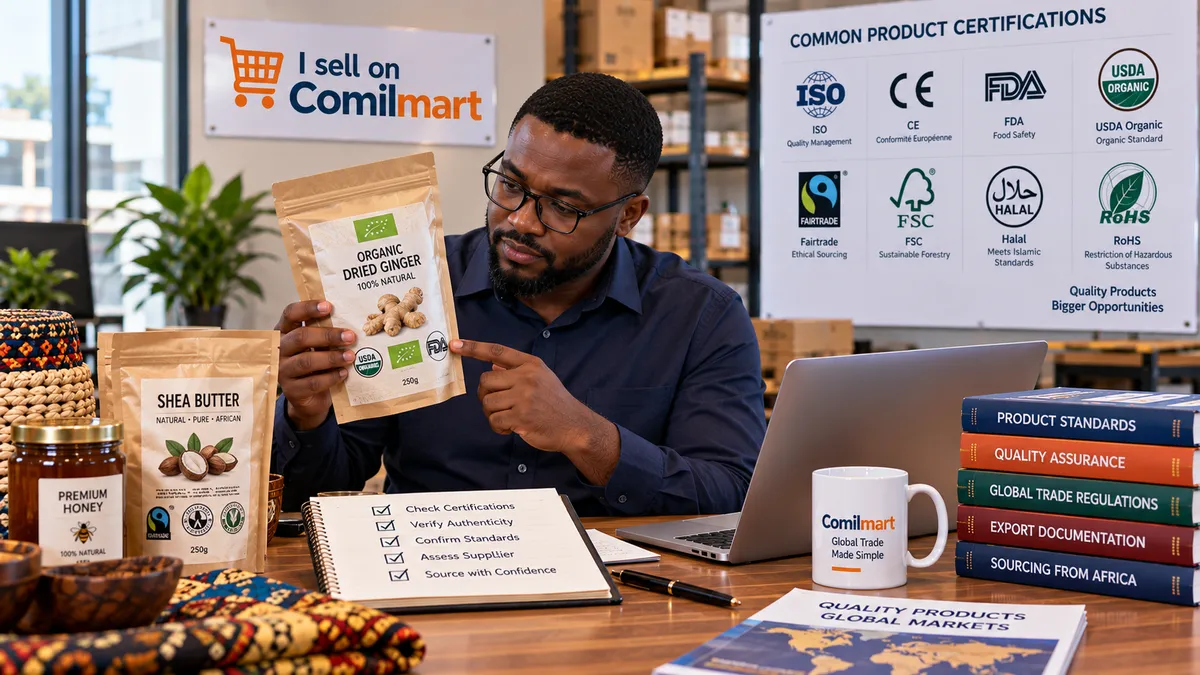
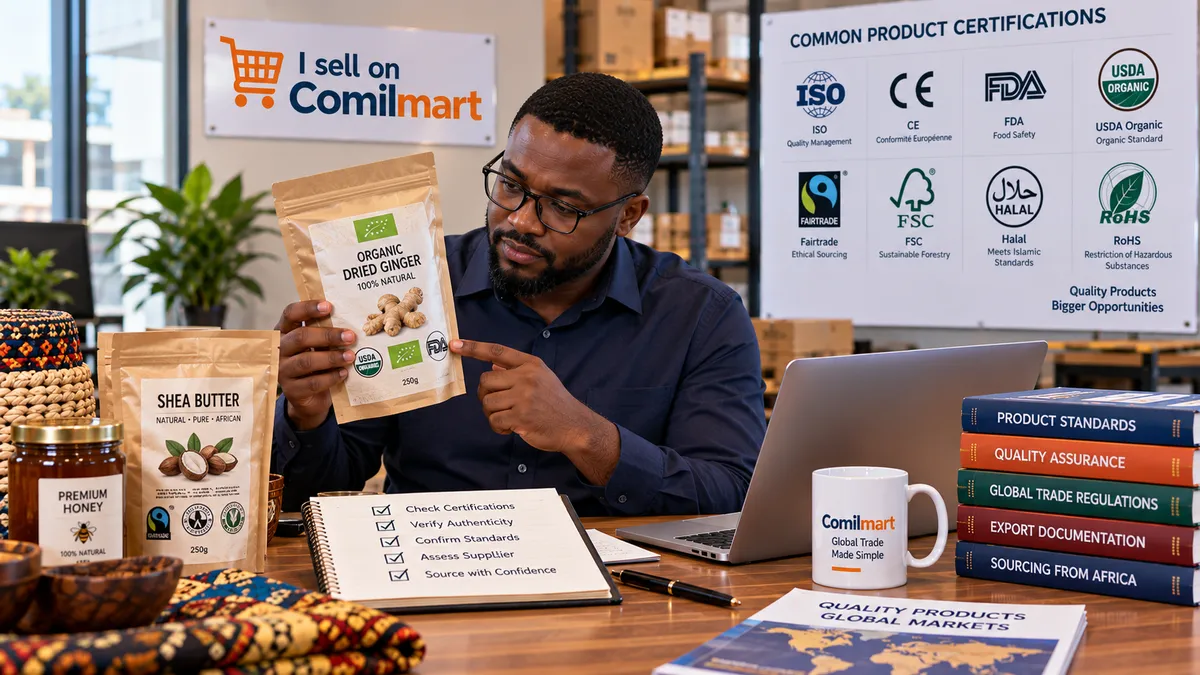
Product listings often display certification badges — CE, ISO 9001, FDA, RoHS, and dozens of others — but most buyers have only a vague sense of what these actually confirm. Some certifications are rigorous, independently audited, and legally required for certain markets. Others are looser, self-declared, or apply to something narrower than buyers assume. This guide breaks down what the most common certifications actually mean, why they matter, and how to evaluate a certification claim rather than just trusting the badge itself.
Why certifications exist at all
Certifications exist to solve a genuine information problem: a buyer usually can't personally test a product's safety, material composition, or manufacturing quality standards before purchasing. A certification is a third party's stamp confirming that a specific standard has been verified — in theory, letting you trust that verification instead of needing to independently confirm every technical detail yourself.
The key phrase there is "in theory." Certifications vary enormously in how rigorously they're actually verified, which is exactly why understanding the differences matters rather than treating every badge as equally meaningful.
CE marking
CE marking indicates a product meets European Union health, safety, and environmental protection standards, and is required for many product categories to be legally sold within the EU. It's one of the more consequential markings because it typically has real legal weight — a product falsely bearing CE marking without actually meeting the underlying requirements can create genuine legal exposure for whoever imports or sells it.
What's worth understanding: CE marking is largely self-declared by the manufacturer, based on their own conformity assessment against the relevant standards — it isn't always independently tested by a third-party lab, depending on the product category and risk classification. For higher-risk product categories, third-party assessment is required; for many others, manufacturer self-declaration is the standard path. This doesn't mean CE marking is meaningless — false CE marking carries real legal consequences — but it does mean the marking alone doesn't guarantee independent lab testing occurred for every product category.
ISO 9001
ISO 9001 certifies a company's quality management system, not a specific product. It confirms that a manufacturer has documented, consistent processes for quality control, and is periodically audited against that standard by an accredited certification body. This is a genuinely useful signal about organizational consistency and process discipline — a factory maintaining ISO 9001 certification is demonstrating an ongoing commitment to structured quality processes, not just a one-time check.
What it doesn't confirm: ISO 9001 says nothing about any specific product's actual performance, safety, or material composition. A factory can be ISO 9001 certified and still produce a defective batch — certification confirms their process for catching and addressing that, not that it can never happen at all.
FDA registration and clearance
This one is frequently misunderstood, and the distinction matters a lot. "FDA registered" simply means a facility has registered with the U.S. Food and Drug Administration, as required for certain product categories — it is not an FDA approval or endorsement of the product's safety or effectiveness. "FDA cleared" or "FDA approved," by contrast, indicates the product has actually gone through a specific FDA review process for its category, which is a substantially more rigorous claim.
If a listing says "FDA registered" but implies this means the product has been reviewed and approved by the FDA, that's a meaningful overstatement worth questioning directly. These are genuinely different claims, and the difference matters especially for anything related to food contact, medical use, or health claims.
RoHS compliance
RoHS (Restriction of Hazardous Substances) confirms a product doesn't exceed specified limits for certain hazardous materials — lead, mercury, cadmium, and several others — primarily relevant for electronics and electrical products. Like CE marking, RoHS compliance is often self-declared by the manufacturer based on their own material sourcing and testing, though third-party lab testing is also common and can be requested as supporting documentation.
Other common marks worth knowing
- UL certification (Underwriters Laboratories) — a U.S.-based, generally rigorous, independently tested safety certification, particularly common for electrical and electronic products. This one carries meaningful independent testing weight.
- Fair Trade certification — confirms specific labor and sourcing practices were followed, verified through periodic third-party audits, most common in agricultural and craft product categories.
- Organic certification — confirms compliance with a specific organic standard (which varies by country and certifying body), verified through audited supply chain tracking.
How to actually evaluate a certification claim
Rather than treating every badge as equally trustworthy, or dismissing all of them as marketing, a few practical steps help you evaluate a specific claim:
- Ask for the actual certificate document, not just the badge or logo. A legitimate certification has an actual certificate with a certificate number, issuing body, and often an expiration or renewal date.
- Check whether the certifying body is a recognized, accredited one for that specific type of certification, rather than an obscure or self-created "certification" designed to look official without real accreditation behind it.
- Understand what's actually being certified — the specific product, the manufacturing facility's processes, or the company as a whole are three different scopes, and a badge that applies to one doesn't automatically apply to the others.
- Be specifically skeptical of certifications relevant to safety or health claims — food contact materials, medical devices, children's products — where the stakes of a false or overstated claim are highest, and where asking for real documentation before purchasing matters most.
How Comilmart handles certification display
On product listings, suppliers can add structured certification information — the certification name, issuing body, certificate number, and, importantly, an uploaded document showing the actual certificate. This structure exists specifically so a certification claim isn't just a badge with no supporting evidence behind it; buyers can see the real documentation directly on the listing rather than needing to request it separately.
Frequently asked questions
Is a product without any certification badges automatically untrustworthy?
No — not every product category requires or commonly carries formal certification, and plenty of genuinely well-made products in less regulated categories simply don't have relevant certifications to display. The absence of a badge matters much more for product categories where certification is standard or legally required than for ones where it isn't typically expected at all.
Can a supplier legally claim a certification they don't actually have?
They shouldn't, and doing so can carry real legal consequences depending on the specific certification and jurisdiction — but enforcement varies, which is exactly why verifying the actual certificate document matters rather than trusting a badge at face value alone.
What's the single most important certification-related question to ask a supplier?
"Can you share the actual certificate document, including the certificate number and issuing body?" A legitimate supplier with a real certification can produce this immediately. Hesitation or an inability to provide it is itself meaningful information.
A closer look: why self-declared certifications aren't automatically suspect
It's worth pausing on something that often confuses buyers: many legitimate, widely-used certifications rely partly or entirely on manufacturer self-declaration rather than independent lab testing for every single unit. This can sound alarming at first, but it's actually how most modern regulatory frameworks are designed to work at scale — independently testing every single product from every single manufacturer simply isn't feasible, so the system instead relies on manufacturers taking on legal accountability for their declarations, backed by the real threat of serious consequences if those declarations turn out to be false.
This means the practical question isn't "was this independently tested," which frequently isn't the relevant standard at all, but rather "is this manufacturer the kind of business that takes legal accountability seriously." A manufacturer with an established track record, real business registration, and consistent product quality over time is a meaningfully different risk than an anonymous, unverifiable seller making the same certification claim. This is exactly why supplier verification and certification claims work together rather than as separate, unrelated concerns.
Certification scope: product, batch, or facility?
One of the most commonly overlooked distinctions is exactly what a certification actually covers. A few different scopes are worth distinguishing:
- Product-level certification applies to a specific product design or model — meaning it should, in principle, apply consistently to every unit produced to that exact specification.
- Batch-level testing applies to a specific production run and doesn't automatically extend to future batches, even of the identical product, unless testing is repeated.
- Facility-level certification (like ISO 9001) applies to the manufacturer's overall processes and management systems, not to any single product's specific characteristics.
A supplier displaying a facility-level certification badge next to an individual product listing isn't necessarily being deceptive, but it's worth understanding that this isn't the same claim as a product-specific test result. If the distinction matters for your purchase — particularly for anything involving safety or health claims — it's worth asking directly which scope actually applies.
Regional variation: the same product marketed differently in different markets
Certification requirements vary significantly by destination market, and a manufacturer exporting globally often maintains different certifications for different regions — CE for the European market, FCC for the U.S. market, and so on. This is normal and expected, but it does mean a certification badge relevant to one market may not be the one that actually matters for your specific location. If you're importing into a market with its own distinct regulatory requirements, it's worth confirming the certification displayed is actually the relevant one for where you're importing to, not just an impressive-sounding badge from an unrelated market.
Frequently asked questions
Should I be more cautious about certifications for certain product categories specifically?
Yes — anything related to food contact, children's products, medical use, or electrical safety warrants closer scrutiny of certification claims than lower-risk categories, simply because the consequences of a false or overstated claim are more serious in those areas.
Is a certificate document alone enough to fully verify a claim?
It's a strong starting point, but for higher-stakes purchases, it's reasonable to also check whether the specific certifying body is a recognized, accredited organization for that certification type — a legitimate-looking certificate from an unaccredited or fabricated certifying body is a real pattern worth being aware of.
What if a supplier has a certification pending rather than completed?
This is worth asking about directly rather than assuming either way — a certification genuinely in progress is different from a false claim, and a transparent supplier will usually tell you exactly where they stand rather than implying a completed certification that doesn't yet exist.
Building certification checks into your regular sourcing process
Rather than treating certification verification as an occasional, extra step you only think about for unusual purchases, it's worth building a habit of a few quick checks into every sourcing decision where certification claims appear on a listing: note which specific certifications are claimed, confirm whether the scope is product-level or facility-level, and for anything in a higher-stakes category, request the actual certificate document before finalizing an order rather than after. This takes only a few minutes per supplier relationship, but consistently applied, it meaningfully reduces the risk of relying on a claim that turns out to be weaker than it first appeared.
What this means for suppliers, not just buyers
Suppliers reading this guide should take away something equally important: displaying a certification badge without the supporting document, or without clarity about its actual scope, undersells a genuine certification just as much as it risks overstating a weak one. A supplier with real, verifiable certifications benefits directly from making that documentation easy to find and easy to verify — it's a genuine competitive advantage against sellers who can't or won't provide the same level of transparency, and it's one of the clearest ways to build lasting buyer trust in a marketplace where verification matters as much as price.
The bottom line
Certifications are genuinely useful signals when they're real and appropriately understood — but a badge alone, without the underlying documentation, tells you less than it appears to. Taking a few minutes to understand what a specific certification actually confirms, and asking for the real certificate when it matters, turns a certification badge from a piece of marketing into the genuinely useful verification tool it's meant to be.