
Sourcing & Trade Guide
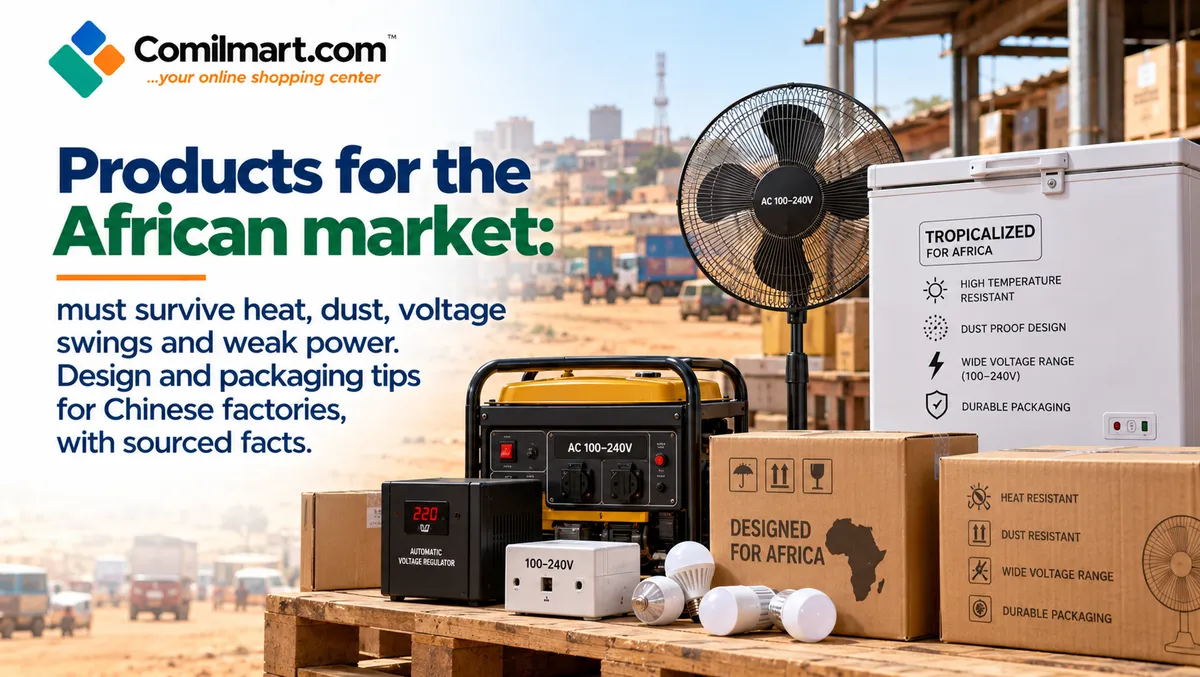
Products for the African Market: Heat, Dust, Voltage (2026)
Comilmart Team
October 12, 2026
A product that performs in a Shenzhen showroom can fail in Kano or Kampala. Designing products for the African market means planning for heat, dust, humidity, voltage swings and unreliable power, along with local plugs and standards. This guide combines general manufacturing advice with facts from the World Meteorological Organization (WMO), the World Bank and the US government's voltage reference. Statements are as of October 2026. Electricity supply and standards vary by country, region and even street, so verify with the buyer and the national regulator before you finalise specifications.
Why products for the African market need different design
The WMO's State of the Climate in Africa 2024 report says Africa has had its warmest decade on record and that 2024 was one of the warmest years on record, with droughts and floods affecting lives and livelihoods. Those are continent-wide statements and local climates differ widely. For manufacturers, the practical lesson is that high ambient temperature, dust and seasonal humidity are normal operating conditions in many markets, not exceptions. Collect the real conditions from your buyer: coastal humidity and inland dust, for example, stress products in different ways.
Voltage and frequency: what the sources say
The US International Trade Administration's electric current reference lists, for example, Nigeria at 220/380 V and 50 Hz, Kenya at 240/415 V and 50 Hz, Ghana at 240/415 V and 50 Hz, Egypt at 220/380 V and 50 Hz, and shows South Africa varying by city between 220/380 V and 250/433 V, all at 50 Hz. The page has no clear update date. The reference site World Standards gives different nominal figures: 230 V and 50 Hz for Nigeria, Ghana, Egypt and South Africa and 240 V and 50 Hz for Kenya. Plug types also differ between the two sources, and World Standards notes that sockets in Nigeria and Ghana are often universal types. Treat these as nominal figures, not guarantees. The practical takeaway is that 50 Hz is consistent across these markets, nominal voltage is roughly in the 220 to 250 V range, and plugs vary. See the ITA electric current page and the World Standards table (its South Africa page also lists 230 V and 50 Hz).
Do not ship 110 V products to these markets. Confirm voltage, frequency and plug type on the proforma invoice and on the product label, and consider offering region-specific plug variants. Regulations on electrical safety may also apply; see our standards guide.
Unreliable power: design for outages and surges
The World Bank reports that 581 million people in Sub-Saharan Africa lacked electricity access in 2023, with roughly 40% of people in Nigeria lacking access. A World Bank working paper (Policy Research Working Paper 10510, June 2023, using 2006 to 2019 survey data) found that 45.9% of firms in Sub-Saharan Africa said power was a major or severe constraint. That data is dated, but the direction is clear: many customers use generators, inverters and solar-battery systems, and mains power can drop or fluctuate. See the World Bank electricity access page.
The paper notes that voltage problems are a constraint survey data cannot easily capture, so we cannot give a figure for them. These general design practices still help:
- Wide-input power supplies that tolerate low and high mains voltage, tested at the extremes.
- Surge and over-voltage protection on sensitive electronics.
- Soft restart behaviour after power returns, particularly for compressors and motors.
- Compatibility with generators and inverters, stated in the manual.
- Low-power or DC options for solar customers; see our guide to solar and power equipment.
Products for the African market: heat, dust and humidity
General advice, not tied to a regulation: choose components rated for higher ambient temperatures than the product needs in a lab, allow airflow and filter access, and avoid plastics that yellow or warp under sun. For dust and water exposure, use an ingress-protection (IP) enclosure rating that matches the environment. The International Electrotechnical Commission (IEC) lists IEC 60529, "Degrees of protection provided by enclosures (IP Code)"; ask your lab which rating suits your product. Coat circuit boards where humidity is high and use corrosion-resistant fasteners. Ask the buyer where the product will be installed, indoors or outdoors, and test accordingly.
What to put on the specification sheet
Give buyers a one-page sheet that answers the questions their customers will ask. Useful lines include rated voltage range and frequency, plug type, rated power or current, operating temperature range, the ingress-protection rating if you have tested it, whether it works with generators or inverters, warranty terms, and which spare parts are available and from where. Be careful to state only what you have tested. If a product has not been tested at high temperature or low voltage, say so, or ask your laboratory to test it before you make the claim. A realistic sheet reduces returns, which are expensive to handle across borders.
Packaging for long humid journeys
Sea freight can run 20 to 45 days overall according to Maersk, followed by port handling and inland trucking, so packaging should survive moisture, rough handling and stacking. Use moisture barrier bags with desiccant, corner protection, strong cartons and clear handling marks. Our labelling and packaging guide covers markings. Pack manuals in English, and in French where relevant, with clear voltage and warranty information; see selling to French-speaking Africa.
Frequently asked questions
What voltage do African countries use? Sources list nominal figures from roughly 220 to 250 V at 50 Hz, but they differ, so confirm with the buyer.
Do I need special plugs? Plug types vary and sockets are often universal. Fit the plug the buyer specifies.
Should I add surge protection? For electronics and compressors, it is a sensible design choice given reported power constraints.
Is there an official climate source? The WMO publishes the State of the Climate in Africa report annually; read the 2024 edition.
Does Comilmart test products? No. Specify clearly and let buyers see your product details.
Getting started
If you build products for the African market with real conditions in mind, tell buyers about it. See /sell-to-africa and apply at /apply-manufacturer. Applying is free and the form states review takes about 24 to 48 hours. Comilmart cannot guarantee buyers or orders; clear specifications help buyers choose.
Related guides
- How to Price Your Products: A Profit Margin Guide for African Sellers
- How to Source Products From Africa: A Guide for International Buyers
- What Is an HS Code? How to Classify Your Products for Import and Export
- How to Start Exporting Products: A Beginner's Guide for Manufacturers
- How to Sell on a B2B Marketplace: A Guide for Manufacturers and Wholesalers
- What Is a B2B Marketplace and How Does It Work? A Complete Guide